
Recently I have seen a mom who asked me to see her due to severely damaged nipples and excruciating pain at the latch. This is one of the most common reasons why families seek the help of International Board Certified Lactation Consultant. Usually, here in Toronto, they try first very available free breastfeeding help and sometimes it’s completely enough. However, in complicated cases, you might need much more help than it’s possible to get in the clinic setting. At the comfort of your home, your baby feels more relaxed as you do not need to travel anywhere, you feel more at ease, can try all your furniture for the most optimal positioning and, usually, the results are much better.
Every single time seeing that I cannot realize how someone can latch their baby once again when instead of nipples you have just plain wounds. Folks, praise yourself for such truly heroic efforts and supernatural pain tolerance threshold. You should know that this is not normal, you are not supposed to suffer that much and your nipples are not supposed to get “callouses” as sometimes you can be told by health care providers. Pain and physical damage are the indicators something is very wrong and should not be continued the same way. Some people have naturally very low pain tolerance, it’s true, however, even they should be able to tolerate the baby’s perfect and deep latch without any pressure on their nipple.
This particular mom’s baby was 5 days old and her nipples were looking just very damaged and sore. She began pumping and hand expressing, so the nipples could get some break. Her expressed milk was of bright yellow color, as it would be colostrum. It appeared that if a breastfeeding mom is on a ketogenic (or just keto) diet, her milk often gets that so-called golden milk appearance possibly due to higher milk fat concentration and the energy content of milk. A random pic (photo credit: Julie Scholten) found on social media shows that difference in color between pumped milk while on the 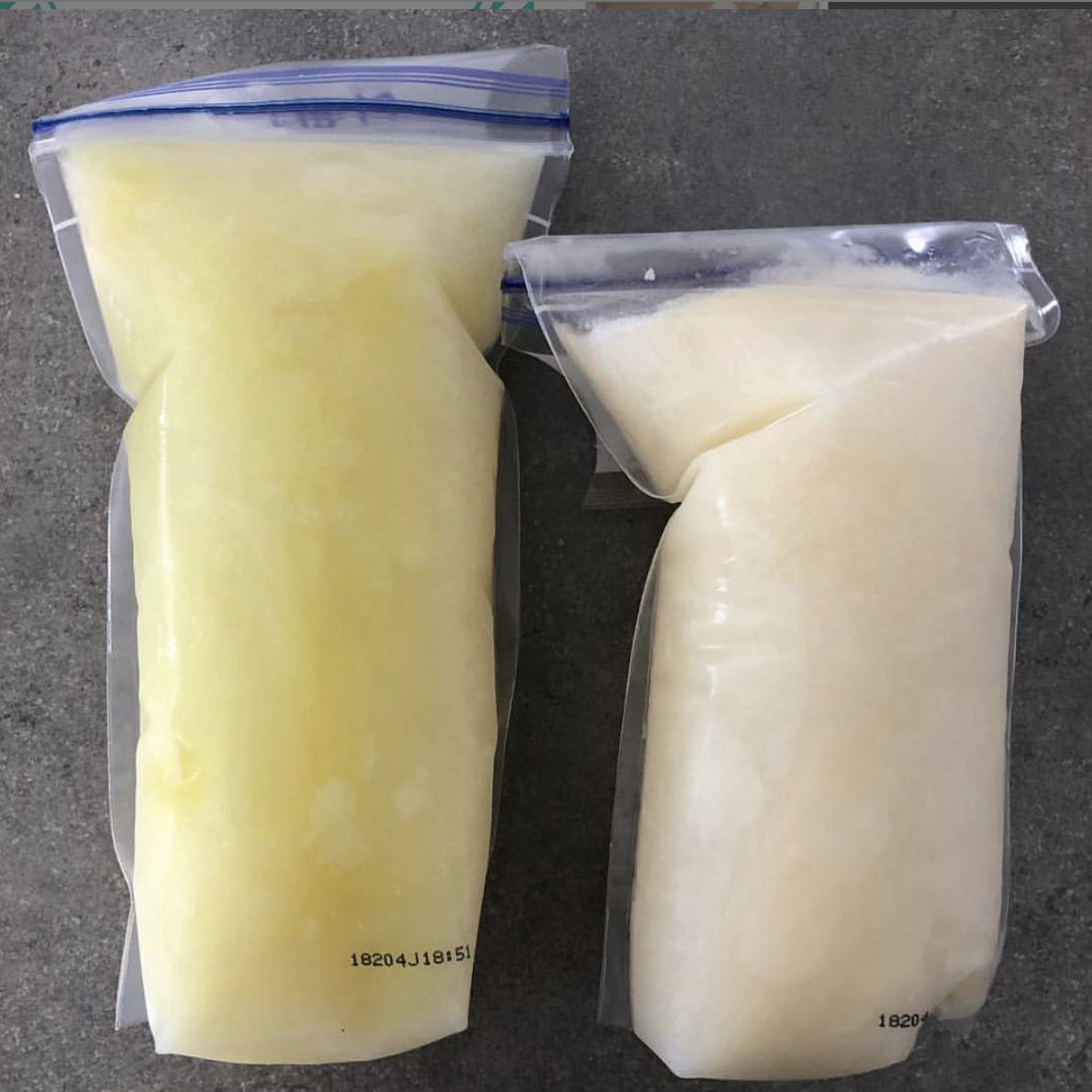 keto diet (left one) and pumped milk while on a regular diet (right one). Due to overwhelming rates of obesity and its negative impact on health, causing billions of expenses from the health care system, the keto diet has become very popular these days all over the world. And those who follow it claims it shows good results. However, many people use it to reduce inflammation in body tissues or to help other conditions, such as seizures, or, like in this case – multiple sclerosis. This article is not about how to treat yourself from autoimmune diseases or how to start a keto diet while breastfeeding, rather just to give a heads-up that anything is possible if you have your particular breastfeeding goals and you’re struggling in achieving them. Before following any diet, please see your doctor and discuss everything regarding your health status and possible outcomes. Educate yourself on a chosen diet and how to follow it properly. Know the facts and the myths and avoid possible mistakes.
My job as a Lactation Consultant’s was to make sure that my client could be able to reach her breastfeeding goals as we both know that breastfeeding has lots of longlasting health benefits for both mother and a baby. For most patients, multiple sclerosis symptoms disappear during pregnancy. It cannot be transferred to the baby during the pregnancy or while breastfeeding, that’s why your breast milk is completely safe for the baby. Studies suggest that disease symptoms might be related to the changes in hormone levels that happen during ovulation and period, which usually go on hold when you’re exclusively breastfeeding, as well as hormones prolactin and oxytocin triggered by regular, intense breast milk removal from the breast while suckling. Depending on your immune system status, they’re most likely to return in the first 6 months after giving birth, often between 4 and 8 weeks. Studies suggest that exclusive breastfeeding won’t make your multiple sclerosis worse, and it may actually delay an MS relapse. The key seems to be exclusive breastfeeding, for at least 2 months. Nobody can predict how long your body will remain in lactational amenorrhea as it depends on your prolactin le